Blog
Salmon, Sovereignty, and the River That Refuses Borders
People often see rivers as lines on a map, marking boundaries between states. But for those who live alongside them, rivers are not just borders. They are lifelines.
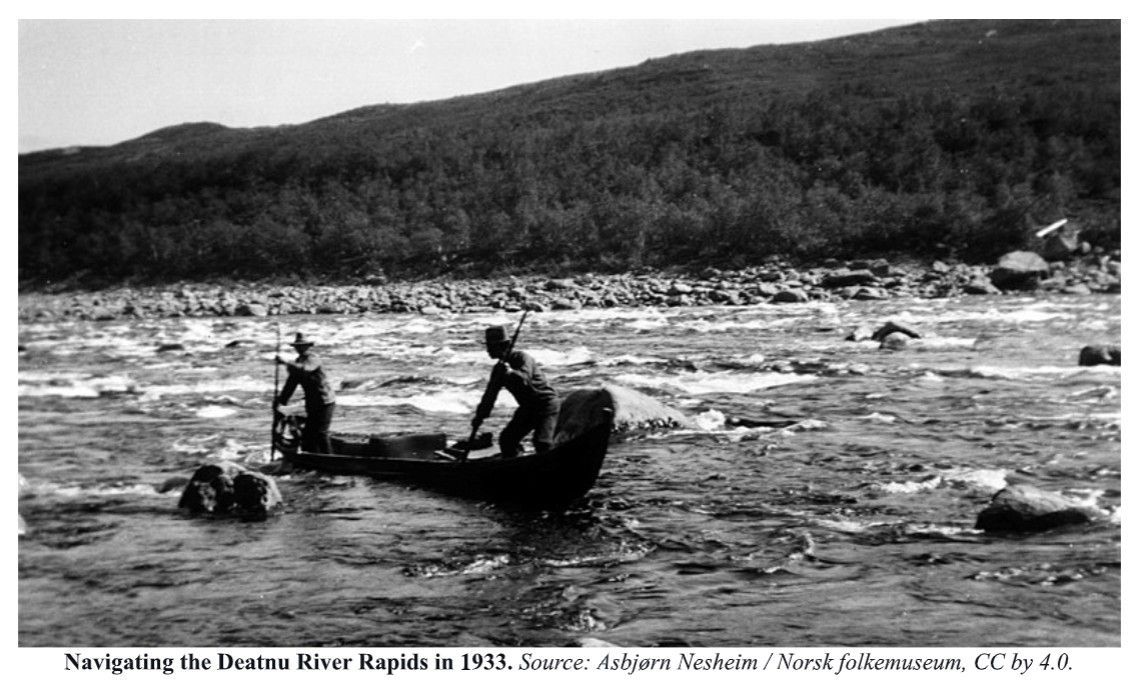
The Deatnu River, called the Tana in Norwegian and the Teno in Finnish, is one of Europe’s most important wild Atlantic salmon rivers. It runs between Norway and Finland and forms a political boundary. But long before that border, the river was and still is a central part of Sámi life.
For generations, Sámi communities have lived along the Deatnu. They developed skilled salmon-fishing practices based on deep ecological knowledge, cultural traditions, and teachings passed down through families. Here, fishing is not just about making a living or recreation. It is a way of connecting with the river, the salmon, and with one another.
Today, however, that relationship is under pressure as new conservation measures reshape river life.
When Conservation Becomes Control
In recent decades, worries about falling salmon numbers have led to stricter conservation rules. At first, these policies seem necessary and even urgent. Salmon are at risk, and real environmental pressures like climate change and industrial activity play a role.
But conservation is not neutral—it can shift power and influence over the river.
In the case of the Deatnu River, regulatory frameworks imposed by the Norwegian and Finnish states have significantly limited traditional Sámi fishing practices. These include strict quotas, reduced fishing days, and licensing systems. Such rules often disadvantage local Indigenous fishers while still allowing tourists access.
The result is a paradox: policies designed to protect the river are simultaneously undermining the very communities that have sustained it for centuries.
This raises a critical question: What happens when conservation efforts reproduce the very inequalities they claim to address?
Knowledge Systems in Conflict
At the heart of this issue is a deeper tension between different ways of knowing.
State management systems usually focus on scientific models, numbers, and decisions made from the top down. These methods are often seen as objective and evidence-based. In contrast, Sámi knowledge, called árbediehtu (traditional knowledge) and árbemáhttu (traditional skills), comes from long-term observation and lived experience. It is based on a close understanding of ecosystems.
For example, Sámi fishers pay close attention to subtle environmental indicators, such as water temperature and fish movement. They watch seasonal changes and predator patterns. Their practices include not only how to fish, but also when to avoid fishing. This helps protect spawning cycles and lets salmon populations recover.
These are not informal or anecdotal insights. They are part of a coherent system of ecological stewardship. This system has developed over generations.
Yet in many regulations, this knowledge is deemed less important or omitted entirely.
The implication is clear: not all knowledge counts equally in decision-making processes.
The Problem of the Border
The Deatnu River is also a transboundary river. It is governed through agreements between Norway and Finland. While these agreements aim to coordinate management, they also introduce additional layers of complexity.
For the Sámi, whose traditional lands cross today’s state borders, the river has never been split. Families, communities, and fishing traditions exist on both sides. However, current government systems see the river as a shared resource between the two countries. They do not treat it as a single cultural landscape.
This creates situations in which Indigenous rights are fragmented or inconsistently recognized across jurisdictions.
At a deeper level, this shows a gap between political borders and the real lives of Indigenous people.
A Legal Turning Point: The Veahčajohka Case
In 2017, a group of Sámi individuals deliberately fished without a license in a tributary of the Deatnu River, asserting their traditional rights. They reported themselves to the authorities, initiating a legal challenge.
The case eventually reached the Finnish Supreme Court, which ruled in favour of the Sámi fishers. The Court recognized that the application of state fishing regulations had violated their constitutional right to maintain and develop their culture.
This decision was important. It confirmed that Indigenous cultural practices, including fishing, are not just old traditions but living rights that have legal recognition.
At the same time, the case highlights an ongoing issue: Why must Indigenous communities resort to legal confrontation to assert rights that predate the state itself?
Beyond legal battles, more is at stake: What is at Stake?
It might seem simple to see this issue as a fight over who can fish, when, and how much. But this view contrasts sharply with the more complex reality faced by the Sámi.
What is at risk is not just access to salmon, but also the survival of a knowledge system, a language, and a way of life.
When fishing practices are limited so much that they can’t be properly taught to younger generations, the effects last beyond one lifetime. Skills, stories, and relationships connected to the river could disappear.
In this way, the Deatnu is not only an environmental issue. It is also a cultural and political one.
Rethinking Conservation
The challenges facing the Deatnu River are real. Salmon stocks require careful management. Climate change, industrial impacts, and overfishing all contribute.
But effective conservation cannot be achieved by sidelining Indigenous knowledge and rights. In fact, this approach directly contrasts with sustainability efforts: ignoring local expertise can undermine, not enhance, environmental outcomes.
More and more research shows that lands and waters managed by Indigenous people often have healthy ecosystems. This is not by chance. It results from management systems that adapt, use local knowledge, and rely on long-term relationships.
For the Deatnu, this suggests a different approach: co-management. Under this model, Sámi knowledge holders do more than just give advice. They help make decisions.
It also means changing how we see Indigenous practices. Instead of treating them as something to control, we should recognize them as part of the solution.
A River That Refuses Simplification
The Deatnu River cannot be easily defined. It is ecological, cultural, legal, and political at once. The river links countries, but also shows the limits of borders. It supports life and highlights debates about how that life should be managed.
Most importantly, it asks us to rethink what sustainability means and who it is for.
If conservation is truly going to last, it must consider not just species and ecosystems, but also honour the people whose lives and traditions are inseparable from them. Only then can a river like the Deatnu, and all it sustains, endure for generations to come.
Read More
This blog offers a brief overview of some of the key themes explored in my article:
“Salmon, Sovereignty, and Sustainability”
World History Bulletin, Fall/Winter 2025
The full article looks at these issues in more detail, covering historical background, legal systems, and comparisons with other cases:
https://www.thewha.org/world-history-bulletin
or
https://www.researchgate.net/publication/399802258_Salmon_Sovereignty_and_Sustainability
With gratitude for the encouragement of
Øyvind Ravna and his graduate law course, Indigenous Peoples’ Rights to Land, Resources and Livelihood, and
Else Grete Broderstad and her graduate course on negotiations and consultations in northern and Indigenous areas.
Note: This publication is academic in nature, and no payment was received for its development or publication.
From Colonial Project to Indigenous Governance: Reindeer Herding in North America
Securing Futures: Lessons from Reindeer Herding for Indigenous Economic Development
Reindeer herding in North America represents an economic experiment shaped by colonial intervention, Indigenous adaptation, and the emergence of Indigenous-led governance.
My research traces this development from the U.S. government’s introduction of reindeer to Alaska in the late nineteenth century to the contemporary management of Canada’s only herd by the Inuvialuit Regional Corporation (IRC). However, the historical trajectory is more complex than it initially appears.
This account examines how Indigenous communities transform imposed systems into instruments of self-determination.
Reindeer Herding in North America Began as a Colonial Project
Reindeer were not native to Alaska or Canada in their domesticated form. They were introduced in the 1890s as a government response to a perceived crisis: declining caribou populations and fears of famine among Inuit communities - famine that had been created in part through their own policies (e.g., relocation).
To implement this solution, the U.S. government recruited Sámi herders from northern Scandinavia—experts in reindeer pastoralism—to train Indigenous communities in Alaska. This initiative, often referred to as the “Reindeer Project,” was framed as both humanitarian and economic.
However, the initiative was fundamentally colonial in nature.
The program was designed and controlled by government and missionary authorities. Indigenous participants—primarily Inupiat and Yup’ik—were positioned as apprentices within a system that they did not design. Even the economic structure reflected this imbalance: Indigenous Sámi herders were granted ownership and autonomy over herds, while local Indigenous participants faced restrictions on slaughter, sale, and inheritance.
Reindeer herding, in this early phase, functioned as a tool of governance as much as a source of food.
Indigenous Peoples Transformed the Project on Their Own Terms
Despite these constraints, Indigenous communities did not passively adopt reindeer herding. Instead, they adapted and reinterpreted the practice to fit their own contexts.
Over time, Inupiat and Yup’ik herders integrated reindeer into broader subsistence economies alongside hunting, fishing, and seasonal mobility. The practice became one strategy among many, rather than a total replacement for existing lifeways.
Equally significant were the circumpolar relationships that formed between Indigenous Sámi and local Indigenous communities. Historical records and letters suggest mutual respect, shared knowledge, and, in many cases, intermarriage. These relationships complicate any simple narrative of cultural imposition.
Instead, this period is characterized by intercultural knowledge exchange occurring under conditions of structural inequality.
Reindeer herding in North America was not merely transferred but actively recontextualized by Indigenous actors.
Economic Development Was Structured—and Constrained—by Policy
By the early 20th century, reindeer herding had grown substantially. Herds expanded into the hundreds of thousands, and reindeer became integrated into regional economies, including transportation during the gold rush.
However, this growth also attracted non-Indigenous commercial interests.
Companies like the Lomen Corporation consolidated large herds and sought to scale reindeer into a global meat industry. This introduced new tensions: land use conflicts, questions of ownership, and the risk of Indigenous displacement within an industry originally intended for their benefit.
In response, the U.S. government enacted the Reindeer Industry Act of 1937, which legally restricted reindeer ownership in Alaska to Native American Indigenous peoples. This policy reduced the ability of non-local Indigenous (Sámi) and non-Indigenous groups to participate in the reindeer industry by barring them from owning reindeer. As a result, community control among Native groups increased, economic benefits were redirected to these communities, and the balance of power in the reindeer industry shifted away from outside groups.
While intended as a protective measure, this policy also produced significant side effects. The legal requirement that reindeer herd ownership be Indigenous meant that Sámi herders—despite being key to the industry's success—were formally excluded and forced to divest their herds, leading most to leave Alaska. This exclusion not only altered the economic opportunities for Sámi participants but also fundamentally changed the industry’s composition—limiting diversity and redefining who could participate, with lasting impacts on the broader development of reindeer herding.
This moment highlights a recurring pattern that economic development initiatives are shaped, and at times disrupted, by policy decisions.
The Canadian Context: Reindeer Herding as State Intervention
Canada adopted a similar approach in the early 20th century.
Facing its own concerns about caribou decline and northern food security, the Canadian government purchased thousands of reindeer from Alaska and initiated a large-scale herding project in the Northwest Territories.
Sámi families were again recruited—this time to lead a multi-year migration of reindeer across the Arctic to the Mackenzie River Delta. This journey, often referred to as the “Great Reindeer Trek,” proved to be both logistically ambitious and symbolically significant.
As in Alaska, the project addressed food insecurity and aligned with state settlement and control goals.
Yet over time, the industry became localized. Inuvialuit participation increased, and reindeer herding became part of the region’s mixed economy.
A Turning Point: Indigenous Ownership and Governance
The most significant transformation occurred in the late twentieth and early twenty-first centuries.
The 1984 Inuvialuit Final Agreement led to significant policy changes, including the transfer of land rights, financial resources, and administrative powers to the Inuvialuit. This shift in legal authority created the foundation for self-governance, provided new opportunities for economic expansion, and increased the Inuvialuit community’s ability to influence regional policy decisions. These policy impacts were instrumental in enabling direct community control and greater prosperity.
As a result of this agreement, the Inuvialuit Regional Corporation (IRC) emerged as a central institution. Unlike earlier phases of reindeer herding, in which control rested with governments or private companies, the IRC reflects Indigenous ownership, management, and strategic governance.
This shift culminated in 2021, when the IRC acquired Canada’s only reindeer herd.
This development is notable for its structural implications: the herd is now managed within an Indigenous governance framework.
- Financial advantages are directed to community members.
- Decisions align with cultural values and long-term sustainability.
Reindeer herding, once a colonial solution, is now a tool of Indigenous economic development.
Beyond Economics: Food Security, Culture, and Governance
Today, the IRC’s approach to reindeer herding is not limited to profit generation.
It is tied directly to:
- Food security in a region where access to affordable, nutritious food is still a major issue
- Cultural continuity, through the revitalization of land-based practices
- Employment and training, including initiatives like the Country Food Processing Plant in Inuvik
This approach provides broader insight into economic development by integrating social, cultural, and ecological priorities.
It also challenges conventional models of economic development.
As the narrative comes full circle, the tension between adaptation and integration becomes increasingly prominent.
This historical account raises a critical question: When Indigenous communities utilize corporate structures and participate in market economies, are they being integrated into colonial systems, or are they reshaping those systems from within? The Inuvialuit case suggests that the answer is not binary. The IRC operates within a corporate framework but is accountable to its beneficiaries—not the state. Its decisions are informed by Indigenous priorities, including the role of Elders, land stewardship, and community prosperity.
Economic development is a site of negotiation between imposed structures and Indigenous governance; the history of reindeer herding in North America is about transformation, not mere expansion.
What began as a colonial intervention evolved, through Indigenous adaptation, resistance, and innovation, into a model of community-controlled economic development.
Today, under the stewardship of the Inuvialuit Regional Corporation, reindeer herding represents something fundamentally different from what it did in 1892.
It is no longer simply a response to a crisis.
It now serves as a strategy for securing the futures of Indigenous communities.
Citation
Salo, M. (2025). Securing futures: The Inuvialuit Development Corporation and the legacy of reindeer herding. Journal of Aboriginal Economic Development, 15(2), 48–81. https://doi.org/10.29173/jaed564
Acknowledgement
This research was originally developed as graduate course research in Dr. Kurtis Boyer’s Indigenous Nation Building course.
Notes
This post is an accessible micro-blog adaptation of a longer published article. The full article is available through the Journal of Aboriginal Economic Development: https://jaed.ca/index.php/jaed
This publication is academic in nature, and no payment was received for its development or publication.
New Paragraph
New Paragraph
New Paragraph
New Paragraph